Sassanian art is the Oriental equivalent to the Western Byzantine era.
This art was a product of the Sassanian Empire that flourished in the 3 rd to 7 th century A.D. For four thousand years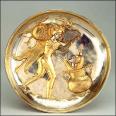 the rich Iranian culture had produced a consistently traditional artistic style; delicate portraits done in pale earth tones, wood carvings, colorful and complex floor mosaics that have survived to some extent till this day, wall murals, marble sculptures, fabulously made Persian carpets using their own special innovations of the art and finally stuko plaster sculptures that adorned the walls and columns of imperial palaces. Under the Sassanian rule, art was cultivated and generously sponsored; they became famous for their great skill in metal work, and the far more unique materials of gold and crystal. The motifs that can be seen in this artistic style would later be used as a template for the Muslim art, in the late 8 th century, with the word of Muhammad spreading across Asia . Most commonly known are the endless variations on flowers and wildlife, beautifully executed and stylized.
